


Certificate IV in Allied Health and Assistance
Overview
Want to help rehabilitate clients? The Certificate IV in Allied Health Assistance teaches you the core skills to work alongside and independently under the guidance of allied health professionals. Gain knowledge and practical skills enabling you to develop and manage therapeutic programs to deliver quality care in a hospital or community rehabilitation setting.
This is a nationally approved vocational course that is recognised throughout Australia.


Apply ATAR-free and secure your future
The best move you’ll make in Year 12 is not leaving your future to chance. Apply for Swinburne’s Early Entry Program now and you could secure an offer before exams – no ATAR required.
Your industry experience
Bolster your CV with real industry experience. This course requires the completion of 120 hours of mandatory supervised clinical placement, typically over a 3 week period.
Swinburne is responsible for sourcing all clinical placements for students. During placement, students will be expected to work 8 hour shifts excluding lunch.
Topics you'll cover
- Basic anatomy and physiology
- Basic physiotherapy / occupational therapy
- Infection control
- Group exercise work
- Working with a range of allied health professionals
Skills you’ll learn
- Conducting basic health assessments under direction
- Adaptability across healthcare settings
- Communicate effectively with patients and healthcare teams
Your career opportunities
- Allied health assistants
- Work in acute and sub acute care hospital settings
- Work in community settings
Why Swinburne?
91.5% of graduates are employed or pursuing further study
87.1% of students are satisfied with their training
80.9% of students are likely to recommend Swinburne
Admissions
Applicants for this course must meet the following entry criteria:
- Satisfactory completion of Year 12 VCE or equivalent
- Be 18 years at the time of placement
This will be assessed at the time of your application. To check your eligibility for this course, visit our entry requirements for international students page.
Course pre-requisites
In addition, students must satisfy one of the following:
Language, literacy and numeracy
Applicants are required to complete a language, literacy and numeracy skills assessment as part of the application process. This will assist in determining course suitability and identifying whether additional support may be required.
The approved online skills assessment tool used to determine language, literacy and numeracy skills within the Australian Core Skills Framework (ACSF) is Basic Key Skills Builder (BKSB).
The levels required for this course are:
- Language and literacy Level 3 and minimum foundation digital skills
This will be assessed at the time of your application. To check your eligibility for this course, visit our entry requirements for international students page.
Inherent requirements
Inherent requirements are the essential tasks that define a job and must be performed for successful execution. This course involves practical and physical demands, as well as behavioural abilities, required for assessments and placements in community services.
These skills are crucial for career progression in the field. The Inherent Requirements information helps applicants assess their ability to successfully participate in and complete the course.
Mental wellness is a state of well-being in which an individual can cope with the normal stresses of life and can work productively and fruitfully. Behavioural stability refers to an individual’s ability to moderate their own behaviour. Stable mental health promotes optimal and safe engagement in all learning environments. Many people who live with mental health conditions complete their studies successfully with appropriate support. This course requires that you can manage multiple demands with engagement, focus and composure. You must be able to manage client content of a sensitive, confronting or traumatic nature with objectivity and accuracy.
Effective communication is the key to providing safe and competent care – without it, the needs of the client cannot be determined. An allied health assistant is required to communicate with a wide variety of people ranging from health care professionals to the person requiring care and their families. You must be able to speak clearly and provide instructions, understand and use non -verbal cues to enhance communication, adjust your communication style depending on who you are interacting with, demonstrate respect and empathy when communicating
Students need to be able to see clearly. For example, read and trascribe documents, notice differences in physical appearance. Hearing:the ability to hear clearly is imperative to safe practice. Some important tasks that depend on being able to hear are: listening to breath sounds, communicating with clients, hearing different vocal tones or sounds.
This refers to being able to use the muscle groups in your body to lift, carry, push, pull, twist and bend. You will be expected to bend, squat and kneel to assit with moving or positioning patients, moving equipment in confined spaces and over defined distances, assist clients with conducting exercises. You will need to use fine motor skills which is the ability to undertake coordinated movements of the hands.
In the clinical environment and in on-campus simulation environments, there can be a requirement for a sustained level of physical and mental performance. You should be able to: stand and walk for extended periods throughout an 8-hour shift, maintain a high level of concentration, performing multiple physical and mental tasks over the period of a day in order to provide safe and effective care to clients.
Other requirements
Please note that the duties of an Allied Health Assistant are quite physically demanding and if there are any concerns, should be considered and/or discussed before applying.
Students must be able to perform the physical activities required to be deemed competent in placement, some examples are:
- Pushing and pulling of equipment and/or patients
- Lifting and carrying of equipment and/or patients
- Day to day activities including prolonged standing, walking, kneeling, squatting, and bending over
- Manual handing of equipment and/or patients
- Hydrotherapy
- Exercise demonstration and facilitation with patients
The following additional criteria for entry apply for this course:
- All applicants must be a minimum of 18 years old at the commencement of the placement
- All students must hold a National Police Check, with no disclosable offences, for the duration of the program, including placement*
- * If a candidate believes there would be a disclosable issue on their National Police Check, a confidential conversation will be required prior to enrolment to determine suitability for work within the healthcare environment.
- All students must hold a current Victorian Working with Children Check (Volunteer or Employee) for the duration of the program
- Students are required to obtain an NDIS worker screening check prior to placement
- It is the student’s responsibility to check the current COVID-19 mask mandate and whether it will affect their ability to undertake placement.
- All applicants will need to demonstrate literacy and numeracy competencies
- Immunisations are a requirement to work within health, and up-to-date evidence of immunisations are required to complete assessment requirements within the workplace. If you are not willing to provide up-to-date evidence, you will not be eligible to complete this program.
Immunisation requirements include the following:
- Measles/Mumps/Rubella
- Diphtheria/Tetanus/ Pertussis (Whooping Cough)
- Tuberculosis
- Varicella (Chickenpox)
- Hepatitis B
- Influenza
- COVID-19
For more information about the minimum immunisation requirements please download the:
- Vaccination for healthcare workers information
- Vaccination of healthcare workers for COVID-19
Additional immunisations may be required in response to any changes in Government policy or the specific requirements of the organisation you attend for your clinical placement. Further information will be provided at the commencement of the course.
This course requires the use of some software from Microsoft 365 and Adobe. Swinburne allow students to access this software through the Swinburne system at no cost.
Admission requirements
Meeting the minimum entry requirements for the course does not guarantee an offer of a place. See admission requirements for general information about the admission process.
English language requirements
Satisfactory completion of one of the following:
- IELTS overall band of 6.0 (Academic Module) with no individual band below 6.0
- Swinburne’s English for Academic Purposes (EAP 5 Advanced level) with overall 65%, all skills 65% or above
- or equivalent measures available at English language requirements.
Need to undertake an English assessment for entry?
A prerequisite for many courses, the Pearson Test of English (PTE Academic) can now be done at our Hawthorn campus.
Credit transfer
Credit transfer is a formal recognition process that allows students to receive credit for units of competency achieved through previous accredited study at another registered training organisation (RTO).
The number of credits granted will vary and is based on the:
- unit/s that have been successfully completed
- unit currency and status
- qualification requirements
- relevance to the qualification
- Swinburne policy
Recognition of prior learning
Recognition of Prior Learning (RPL) is the process of transferring the skills and knowledge that you have acquired over your lifetime (irrespective of how they were obtained) against the requirements of the unit.
RPL is an assessment process that requires you to provide evidence that demonstrates how you meet the requirements of the unit/s. The amount and types of evidence you will need to provide will depend on the unit requirements.
Finding your fit
At Swinburne, we recognise that not one size fits all. If this course doesn’t meet all your study criteria, check out these alternatives.
-
Certificate III in Health Services Assistance
Course structure
To be awarded this Qualification, students will complete 18 units (ten core and eight electives) and successfully complete a clinical placement of 120 hours.
Please note: Whilst all attempts are made to make this three-week full-time placement available immediately at the end of the course work completion, you will be advised during the course what health provider and date has been allocated to you. While significant effort is made to match students geographically to placements, students do need to be prepared to travel to placements in the event that this is required.
The placement requirements are consecutive three week placement block Monday through to Friday.
Your units
| Units of study | Unit code |
|---|---|
| Core units | |
|
Interpret and apply medical terminology appropriately
Core unit |
BSBMED301 |
|
Respond effectively to behaviours of concern
Core unit |
CHCCCS020 |
|
Support relationships with carer and family
Core unit |
CHCCCS036 |
|
Facilitate the empowerment of people receiving support
Core unit |
CHCCCS038 |
|
Apply basic principles and practices of infection prevention and control
Core unit |
HLTINF006 |
|
Follow safe work practices for direct client care
Core unit |
HLTWHS002 |
|
Assist with an allied health program
Core unit |
HLTAHA027 |
|
Recognise impact of health conditions
Core unit |
HLTAHA049 |
|
Facilitate the interests and rights of clients
Core unit |
CHCADV001 |
|
Engage with clinical supervision and delegation
Core unit |
HLTAHA047 |
| Elective units | |
|
Communicate and work in health or community services
Elective unit |
CHCCOM005 |
|
Provide First Aid
Elective unit |
HLTAID011 |
|
Work with people with mental health issues
Elective unit |
CHCMHS001 |
|
Assist with movement
Elective unit |
CHCCCS002 |
|
Deliver and monitor physical or manual therapy programs
Elective unit |
HLTAHA028 |
|
Support maintenance of functional status
Elective unit |
HLTAHA032 |
|
Assist in rehabilitation programs
Elective unit |
HLTAHA031 |
|
Conduct group sessions for individual outcomes
Elective unit |
HLTAHA033 |
Study requirements
Timetable
- Classes run 2 days per week between 8:30am and 3:30pm, with approximately 12 hours of on-campus attendance per week
- Scheduled days depend on group allocation, with semester and term breaks included in the timetable
- Students must access online resources and attend on-campus classes to consolidate learning
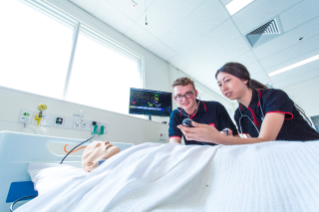
- Practical skills are taught and assessed in a simulated clinical environment
- Students are expected to engage in approximately 10-20 hours of self-managed study outside of scheduled classes
Assessment
- Assessments occur throughout the course and include various methods such as quizzes, case studies, practical observations
- Students must demonstrate required skills and knowledge by satisfactorily completing assessments at different points in the course
2026 fees
Free TAFE eligible students
Full fee* ($AUD)
$22,540
Skills first government-subsidised place* ($AUD)
$6,180
2026 fees
Fees are estimates only
Fees published on this page are estimates only and are subject to change depending on individual circumstances at the time of enrolment. The above fees apply for units studied in 2026 only and may change for units studied in future years. There may be additional costs related to learning material and equipment.
Fees are estimates only
The indicative course fees shown apply to international students for the relevant year, based on a standard study load per year. Fees are assessed according to actual study load each semester, with variations to study load resulting in tuition fee adjustments. These fees generally include the Student Services and Amenities Fee (SSAF) and are subject to annual review. Enrolled students will receive reasonable notice of any fee changes before payment is due.
Skills first government-subsidised place
This training is delivered with Victorian and Commonwealth Government funding. To qualify for a government-subsidised place, you must meet various eligibility criteria. The course you’ve applied for must also be offering government-subsidised places. Swinburne will determine your eligibility by conducting a full assessment of your eligibility during the course application process.
How do I pay my fees?
You can pay your Swinburne fees in person, via credit card, BPAY, or at Australia Post. Check to see if loans and employer sponsored training are also available.
International students need to pay tuition fees up-front by the relevant due date. You can find the due dates on your Statement of Account.
To pay your fees:
- log in to My Finances
- check your Australian bank account details are correct
- check your Statement of Account to see how much you owe
- pay using your preferred payment method.
Eligibility for VET student loans (VSL)
If you apply for a VET Student Loan, Swinburne must first verify your identity. If you are eligible, we will provide your enrolment information to the government so you can complete the application within their eCAF system.
The VET Student Loan amount for this course is capped. You must start repaying this loan once you earn above the compulsory repayment threshold.
Concessions rates for vocational students
If you’re enrolling in a Certificate IV-level program or below, are eligible for a government-subsidised training place and hold a valid concession card, you may be eligible for a concession of 80 per cent off the published fee of your unit(s) tuition – which means you’ll only be charged 20 per cent of the published fee.
Student services and amenities fee
This funding serves to improve the student experience at Swinburne. You may use many or just some of the services and amenities that the fee provides.
From 1 January 2024, all courses at the Diploma level and higher will contribute to the Student Services and Amenities fee.
Please refer to the Student Services Amenities Fee page for more information.
This funding serves to improve the student experience at Swinburne. You may use many or just some of the services and amenities that the fee provides.
This amenities fee is included within your annual tuition fee listed above. The fee shown is the capped amount for 2026.
Please refer to the Student Services Amenities Fee page for more information.
-

Study this course for free in 2026
You could have your tuition fees covered in 2026 thanks to the Victorian Government's Free TAFE initiative.
Free TAFE is available to any Australian citizen, permanent resident or New Zealand citizen.
There are other factors, too. The best way to find out if you’re eligible is to apply!

Scholarships
Scholarship applications for 2026 are open. Scholarships at Swinburne are about providing opportunity, promoting equity and recognising excellence and achievement. We want you to reach your potential and achieve your life and career goals.
Our handy guide will assist you to gather documents for your application.
When you apply for a Swinburne course, we automatically consider you for an international scholarship of up to 30 per cent off your course fees – no separate application required! Just apply for your Swinburne course of choice and when we review your course application, we will also assess you for an international scholarship.
Apply through an agent
Most international students use an education agent to help them through the application process. Swinburne has agents all over the world that can help you with your application to study. Search for a Swinburne representative in your country. If your country is not listed, please contact us.
Apply directly
Ready to take on a new challenge and reach your academic goals? If you already know which course you want to study and understand the entry requirements, what are you waiting for? Apply online! Remember, you cannot apply direct if you have an active VTAC application.